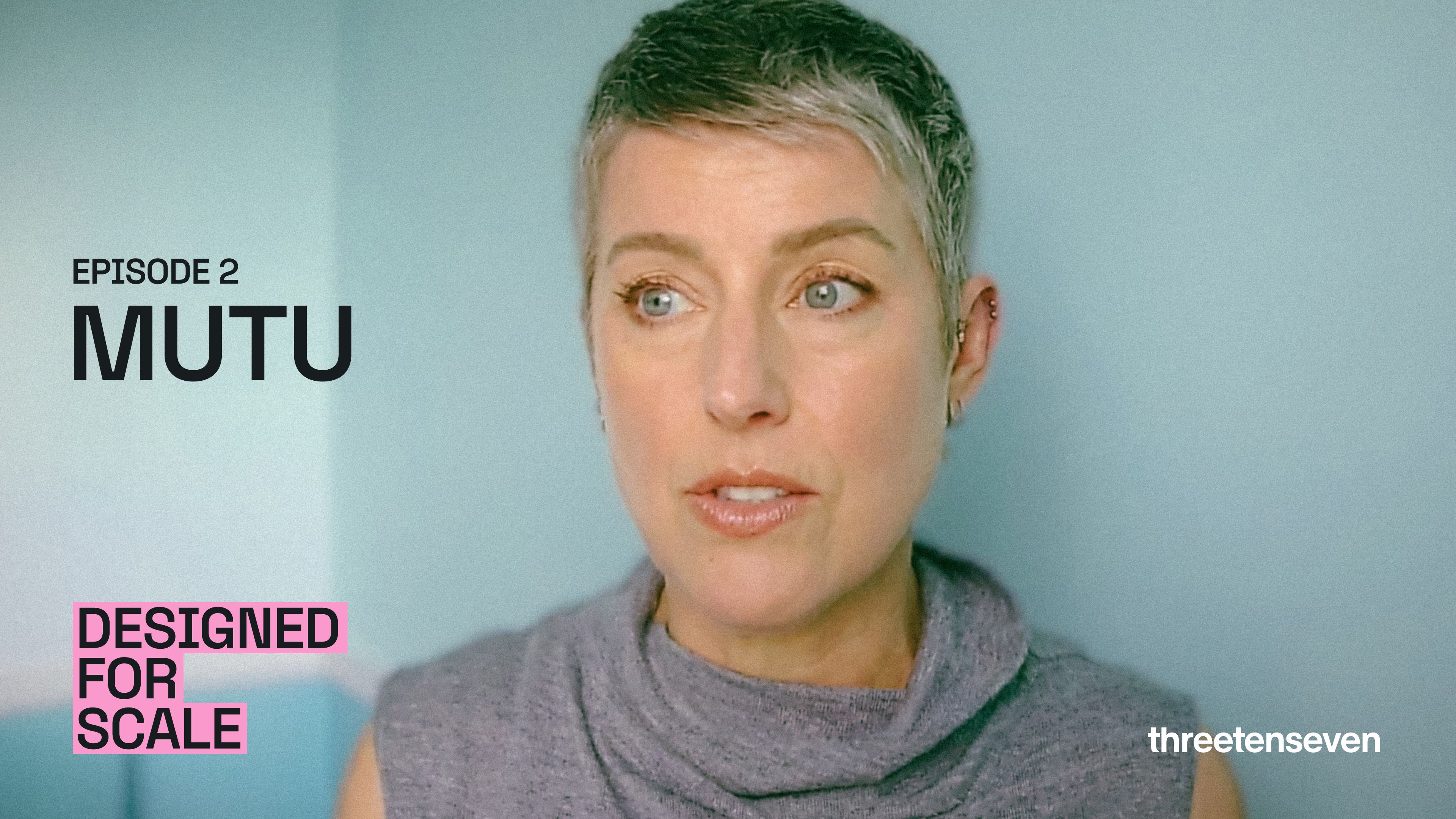
Episode 2: Wendy Powell — CEO MUTU System
MUTU is the NHS-trusted core and pelvic floor programme, but it's growing into something much bigger. We chat to Wendy about how she bootstrapped MUTU into a global movement, without VC investment, the benefits of US market vs NHS, and MUTU's move from postnatal recovery to perimenopause, not to mention how the likes of Kate Middleton and P!NK are involved!
Welcome to Designed for Scale, the podcast where we speak to founders, CEOs and CMOs about how they built and scaled their health tech businesses. I'm Rachel Burrell-Cook, Managing Director of ThreeTenSeven And I'm Chris Skelton, Creative Director at ThreeTenSeven This week we are joined by Wendy Powell who is CEO and founder of MUTU Systems.
Wendy, do you want to explain who you are and where you're from? Absolutely. Hi, I'm Wendy Powell. I'm from MUTU System which is Digital Health for Women's Core and Pelvic Floor. Fabulous.
And we're going to hear today about your story and also more about what MUTU is and does. But I'd love to start by understanding why MUTU started, how it started because I understand it came from your own pregnancy journey but then led you down some quite interesting paths. Is that right? Tell us a bit more about the journey. Yeah, sure.
So originally MUTU started, as you say, from my own birth experiences. So my babies are 18 and 20 now, so it was a little while ago. But before that, I was a certified personal trainer and I was a personal trainer that was already specialising and certified in pre and postnatal fitness. So in theory, I knew all the things. And then I had my own babies and realised that I didn't know all the things.
And what I found was through my own experiences and putting that together with the experiences and symptoms and challenges and issues that my clients for so long had been dealing with. It was kind of that realisation that, look, I'm certified in this stuff. I've got all the bits of paper that say I can do pre and postnatal fitness. But I don't have answers for the diastasis recti, for the incontinence, for the prolapse symptoms, all of the things that were so common. I mean, there's obviously nuance, but these issues were so common to so many of my clients and then, of course, to me.
So I then took that time when my babies were tiny and kind of not restudied, but started looking elsewhere because my industry at the time, which was fitness, it knows a lot more now than it did then about women's bodies and pre-postnatal fitness. But it certainly didn't know much then. And I had all the qualifications that were in existence at the time for that, but I figured, well, somebody must know the answers. So I then took my study. I started working with biomechanics, with sex therapists, with midwives, with OBGYNs, with doctors, on the basis that somebody must know about these bits of a woman's body that fitness doesn't seem to.
And so it's from that, that MUTU was born. The original version of MUTU was a flip camera taped to a tree and me doing exercises in the garden and then working out how to edit it and then Googling how do you put a video online on a website, how do you build a website, how do you put video on a website and how do you get people to pay to watch the video. I literally just Googled it. And what did you have in mind for growth when you first started? Did you imagine the growth profile that you've had in that period?
And where are you in terms of size and scale? Can you give us a bit of a sense of that? I mean, where we are now, MUTU has been through quite a journey in terms of company size. And by company size in that sense, I mean more about the people. The growth has been not always linear for sure, but the growth has been consistent over that time.
But what has changed as well is we, for example, right now, have a team of a lot of part-time people, a lot of freelance people. I've obviously got a small core base of full-time. But if you go back maybe about six years, I had a full-time team of about 15 people. So I've kind of tried all of those different routes. And so this is something that I'm often asked about, but also what I would say for sure is there's no right or wrong.
There are pros and cons to both, to sort of having a very office-based full-time team versus people when you need them or sort of more... Not that they're temporary in the sense they come in and out so much as they just do their thing and they collaborate. And of course, over that time too, tech has changed massively in terms of the tools at our disposal. So we were on Zoom calls years before COVID and before everybody else sort of joined that party. But that's because I've always had team members in the States and in Canada and around the world.
So in terms of size, we're in the hundreds of thousands in terms of paying subscribers and we're involved with NHS contracts and other major health system contracts. But as I say, the structure of the company has changed a lot. And it's always kind of like, "Okay, there's always an upside and a downside, I think, to that sort of thing." But what's been interesting for me as a business owner and going through this journey and this process has been just really knowing that there isn't one right way to do any of this. I think as business owners, we can probably agree with that as well. I know that...
Absolutely. When Chris and I, we bought the business seven years ago at our agency and we're smaller now, but it's considerably smaller than when we first bought it. And the revenue is not dissimilar in terms of the gross profit through the years. It's not dissimilar because we work in a different model and it's so easy to think, "Oh, we need to be big to be successful," but actually being smaller, well, A, it's still got its own challenges, but also there are some absolute advantages to being smaller and using freelance contractors and so on. Not least of all, a slight reduction in stress levels, I would say, by being responsible for fewer people's mortgages.
It does help me sleep a little bit at night through that, so I can definitely hear you on that. Can I just take us back to those early days of clinical validation? Because that's always a really critical aspect of growing a health tech business. Tell us a bit more about how that went in those early days. How much pushback did you get?
How much acceptance did you receive from those people? And how did that transition into what presumably are some fairly strong relationships now that you've got with a community of regular people? Yeah. So in the early days, that outreach to the relevant clinicians, so mostly women's health physiotherapy or physical therapists, that outreach was... I don't think what was in my head was, "I need clinical validation for this," because I certainly wasn't cognizant or aware at all at the time of understanding governance or compliance or working with health systems.
So it wasn't about, “I need these things in place." was much more... It was really about making sure it was safe, because I knew that what I was dealing with was beyond fitness. It was beyond what I knew. I'd been taught to teach as a fitness trainer and as a personal trainer, and I knew very well, because that was my industry and my peer group, that we were having... I was having discussions with clients and we were talking about issues and symptoms that went way past an exercise class.
On top of that, of course, the very nature of what we do at MUTU, that these are intimate issues. We're not talking about a sore ankle here. We're talking about pelvic floor and core. We're talking about most intimate parts of a woman's body feeling completely disconnected. So there's a lot of psychological and mental health and emotional health issues around these things.
I was very, very aware of that. So it's... Yeah, I think at the beginning, I wasn't asking for that validation for those reasons. It was much more about safety and just getting it right. So you mentioned there about being...
So not necessarily being on the App Store, but you're certainly available direct to consumer, direct to patient. What does it look like? What's the revenue split then for MUTU across those different pathways to accessing MUTU? So still very much D2C is our foundation. D2C is our foundation and that split...
I mean, we sell in some more than 100 countries, but predominantly it's US and UK. And of our direct to consumer membership base, that's about 60-40 generally, so around 60% US. So we always... We grew in the US first, very much so. And that wasn't as by design, especially.
That was more about... That was simply where the traction was at the beginning. And so that was where I went. My husband's American, my kids have American passports. So kind of that foot on each side has always been very comfortable for me and very sort of part of my normal.
So when I went very the people reading the blog, the people buying the programme were predominantly in the States, it was like, "Okay, fine. We'll kind of take it to that." So I did a lot of... I've done a lot of training in the States in the sense of training the trainer, certifying trainers, that kind of thing, trainers, physios, midwives, etc., in MUTU techniques. So then it became kind of self-fulfilling in that sense because I kind of went to where the audience was. And then it's more sort of the secondary focus for me was turning my attention back towards the UK a little bit more.
And then of course, with the NHS conversations. So we've always had two conversations going on, as we all know, we speak the same language in theory, but it's pretty different in very many ways. And what appeals and sells and breaks through in those audiences is quite different. I mean, just to give you an example on that, it's sort of that traditionally in the UK, NHS obviously carries huge amounts of credibility and kudos as it should. And so our clinical evidence and trust that we have with our NHS contracts is really, really important here.
It's not unimportant in the States, certainly not to health systems that counts. It's very relevant. But as far as a consumer in the States goes, they're going to be much more interested in the fact that the Princess of Wales apparently uses MUTU system and P!NK uses MUTU system and that kind of thing. So yeah, it's just kind of placing the language slightly differently in terms of what's important to the audience. Can you go into a bit more detail about that initial break into the US and what it took to get the momentum there?
And interestingly, contrast that with the UK, because I think listening to this will hopefully be interested in both of those sides. And we know from the chats we've had previously with you that those journeys look quite different. Yeah, for sure. So in terms of in the States, so knowing that my audience was there, the early MUTU system was kind of even down to sort of at the time, you couldn't take money in loads of different currencies as as easily as you can now, for example. So it was down to like, well, let's price in US dollars.
It was kind of literally, if that's where the audience is, let's go to them. And then over the years as that started to build and we got more, you didn't really call them influencers then, but it was kind of the Twitter moms and some of those, what we would now term as influencers, started to get a lot of traction amongst them. So there was a lot of referral and a lot of recommendation coming through from quite influential moms in that world. And then I did events over there. So there was a bit of PR around that.
And then at that time as well, I was working with a coach. I've kind of always had a coach in my life at all different stages. And I was working with a coach, again, in the US on the basis that I've always believed that if you want to work with somebody that's done what you want to do, not necessarily in your exact space, but you want somebody that's walked the walk as well as says the right words. And so I was working with an American coach who was very big in the digital space. And it was through contacts through that.
So then there was a lot of PR in the States. So that was how it kind of became self-fulfilling by sort of following my early audience there. And then that was where there was some press coverage. We were on Fox News Health. We had various sort of PR coverage over there.
So that kind of went from that end. And then the UK one, conversely, like you say, there's always been a sort of steady awareness of MUTU because we've been around a long time. We've been clinically validated for a long time. But obviously that NHS relationship and those collaborations and contracts, that's made a big difference in terms of our exposure in the UK to sort of slightly different appealing to a slightly different way of thinking and what people are looking for. But that changes over the years as well.
So it's kind of trying to keep up with different audiences in terms of what they want, what messaging is most useful and most valuable to them, and always having the right credentials and compliance to fit comfortably into all of those markets. It's hard It's hard though, in the NHS It is a real struggle and it doesn't seem to be getting any easier for people despite Wes saying that it's all about digital integration, et cetera. What do you see? Do you think there is still opportunity here for you? Knowing what you know now, would you still pursue the NHS?
So my desire to make MUTU available on the NHS to women free at the point of delivery has always been a passion of mine and the driving force behind why we do continue to have that conversation. I'm not going to pretend there isn't also, of course, a market value in the credibility that comes with having NHS contracts, of course. That makes a big difference to our brand, both in terms of to consumers and to other businesses. Of course, that's a factor. But it's really about that accessibility, which is why we've continued to push.
In answer to your question, I don't want to sound down on it, but I think it's even harder than it used to be. I attend parliamentary roundtables. I was invited to attend Downing Street. I've done quite a lot of work with Dame Lesley Regan and also with Renee Thackar, who used to be president of the Royal College of Obstetricians and Gynecologists. I've been in those rooms and contributed to those conversations.
For me personally, I now feel I'm familiar enough with it and the language of it that I can kind of boundary that time and I can be part of those conversations, but I'm also running a business. Shall we talk about that a little bit then, about the transition and the journey that you're on now from talking about post pregnancy to perimenopause and the challenges maybe around messaging, around including those audiences and what you're doing with the product to help position it in a way that can support women throughout their adult life, really? The solutions don't really change very much, but like you say, sometimes securing all the messaging might. For a long time, and because that was how I built it in the early days, MUTU was originally a postpartum service, a postpartum offering, simply because that was the life stage for me that it had come out of. Then knowing that when you're looking at these things postpartum or a little bit later postpartum, then the obvious understanding that if these things were known and understood better during pregnancy or even pre-pregnancy and how beneficial that would be.
So that's a space that we were always in. Then I think a lot of it comes to in my life stages too, like as I've moved through life and so I've got different things going on with my body and my hormones. So I think that's inevitable too. It's very hard when you've got a founder-led business, it's quite hard not to be influenced by that. But at the same time, because of these partnerships that we have, because of a lot of strategic collaborations that we enjoy, different audiences come into us.
And so we were starting to realise over the last few years, gosh, we're getting a... And we monitor the demographics of our users because we survey them as they come in, so we know a lot about the women that use MUTU. And that 45 plus demographic and age group was just steadily growing. And then around the TENA partnership days, there was that spiked a little bit, understandably, but that really settled as well in terms of this midlife audience. So still very much in the postpartum space, but seeing it older.
And what we also started to see, because we've been doing this for some time, was women coming back to us. So what we would see would be, "Oh, hey, I used MUTU eight years ago when I had my babies, all good, all sorted. And now I'm coming back because I'm now going through perimenopause and I'm starting to see whether it be pelvic floor issues or other issues manifesting because of hormone changes. So now I know where to come back to." So it was partly... It was to an extent people coming in for the first time at different life stages, but it was also our own people coming back.
And we see a lot of that in our community. We've got a private community within our membership site, and we see a lot of women in there who are returning to MUTU. What we've done, as far as messaging goes, there's been subtle shifts like our main landing pages don't just scream new baby at all, whereas maybe in the early days they did a bit. So I suppose there's some subtle imagery or other changes. But the conversation is pretty much the same.
It just depends who you're talking to. The issues are the same and the same. All women, like you said, like brushing your teeth, you just need to take care of your pelvic floor. And if you don't, it's not perfect. And it's just a fact about being a woman.
So I also think that it gives you access to women who aren't bad enough to feel like they need... I'm doing that in inverted commas, bad enough to feel like they need a proper training system. But actually it gives me a way in. So I think that's a really inclusive decision as well as a good market though arguably slightly less differentiated. You've got a really niche audience with the audience that you started with and now you're expanding out to be still quite differentiated and quite niche, but slightly less so.
So in terms of the competition that you have, how are you maintaining your groove there and fighting off other entries into your space? There's a lot about the fitness industry that is very, very aesthetically driven. MUTU isn't. It never has been. We've never focused on fat loss or weight loss.
We've never focused on flat tummy or how you should look or get your body back. So there's a whole world of verbiage and language and messaging around what mums and new mums are bombarded with in their feed in terms of the way they should look and the way their body should be that we kind of don't partake in at all. So that's one area which is differentiated, if you like. We just don't look like that. And then in terms of sort of keeping the messaging tight whilst keeping the life stages wide has been a change in the way that we talk about a lot of these symptoms.
So you'll often see messaging in MUTU around quite simply if something doesn't feel right, it's not you. So a lot of it, because so many of these issues that we deal with, take prolapse, for example, pelvic organ prolapse, 50% of women throughout their life stage will have some level of prolapse. The majority of those will never have an official diagnosis of a prolapse. So simply saying, "This is what we do. This is a program for prolapse," that's not helpful because most people don't even know they're dealing with it.
So where we will differentiate again is instead of lists of symptoms, our content is very much more around, "It feels like this. If something feels like that, if it just feels off, if it feels different, if you feel pressure, if it feels heavy, if it feels all of these different things." So that's another way that we've kind of always differentiated our language in that one, staying away from the aesthetic or weight loss world of pressure, but also always treading that balance between clinical language because we are clinically backed, so it depends who're you're talking to what language you might use, but also very much being really embedded at our core in the language of the woman that finds us, not in the language of a medic. So yeah, those are all sort of different, those are all ways where MUTU sits that is different to and differentiated from an awful lot of other things in that space. We've got two questions that we would like to wrap up with, if that's okay, and the first of those is what you wish someone had told you earlier about scaling a health tech business. Do you know, I think it business.
Do you know, I think it would be simply to know upfront, this will not be a linear process, this is not going to just be this line that does this, it's going to be this and a bit of that, and then another one of those, and that because that's just how business goes. Also because we are not VC backed, so we've never had that level of investment behind us, which is obviously a whole different conversation and sort of again, like big teams and small teams, there's pros and cons of course, but that also because of that, you know, that means that we haven't grown in this linear way that has been huge injection of cash, massive marketing campaign and go. So I think, and I'm very comfortable with the way we went, but I'm also very, you know, sort of aware and work with lots of other business owners that do it in all different ways. So I think, one, it won't be linear, just kind of roll with that, that's business, that's life. And secondly, I guess, the segue to that, the kind of comfortable with that because there isn't only one way to do this.
Our last question is, we like to ask people to recommend someone that we should be talking to about this stuff. I gave you a bit of a pre-warning on this one, so hopefully you've given it a bit of thought. Yeah, it'd be great to know who we should be targeting for our next show. For sure. Thank you for the warning because yes, I did have a bit about it.
And yeah, I was thinking through, I was like, you know, is this a sort of US based, is it UK based, is it sort of super high tech? And you know what I landed on is, is I think that the person I think that you should totally have on is Dr MaryAnn Ferreux who is a health, sorry, chief medical officer within the NHS systems. And she is a phenomenal leader in terms of working to integrate and progress tech within NHS. She's a huge believer, she's a massive ally. She's instrumental to our first contract.
And at the same time, obsessed with equity and obsessed with who are we serving and why? She sounds great. Yeah, that's exactly the type of person that we need. We need more of more of her, but also more opportunities for that integration to happen. Things like Innovative Entrepreneurs is obviously a great program, but it's just so small, and it's just limited I think we need more.
We need more. So she sounds fabulous. Thank you so much. That was really insightful and really rich. And I absolutely love what you're doing with MUTU.
The product's great, but also hearing about your journey and hearing an organic growth journey is really, really fascinating as well, because I don't think it's spoken about enough. So many, you know, we talk about the VC route such a lot, but yours has been a proper story of graft. And I think it's a beautiful, well, it's not a result. It's a beautiful part of the story that we're meeting you at and I can't wait to see where you go next. So thank you.
Thank you. Thank you. It's been an absolute pleasure Thanks